- Written by: SimbaHardik
- June 6, 2026
- Categories: Blog
- Tags:
Introduction
Marketing used to be a guessing game. Brands sent ads and hoped people would respond. Most of the time, they didn’t.
Today, that has changed. Businesses now use data, AI, and machine learning to predict what customers want before they even ask for it. This is called predictive marketing.
Predictive marketing is not a trend. It is quickly becoming a core skill for every digital marketer. If you are looking to grow your career, enrolling in a digital marketing course in Surat that covers AI tools and data analytics is one of the smartest moves you can make right now.
In this blog, we will break down what predictive marketing is, how it works, and why it matters with real examples and practical insights you can apply today.
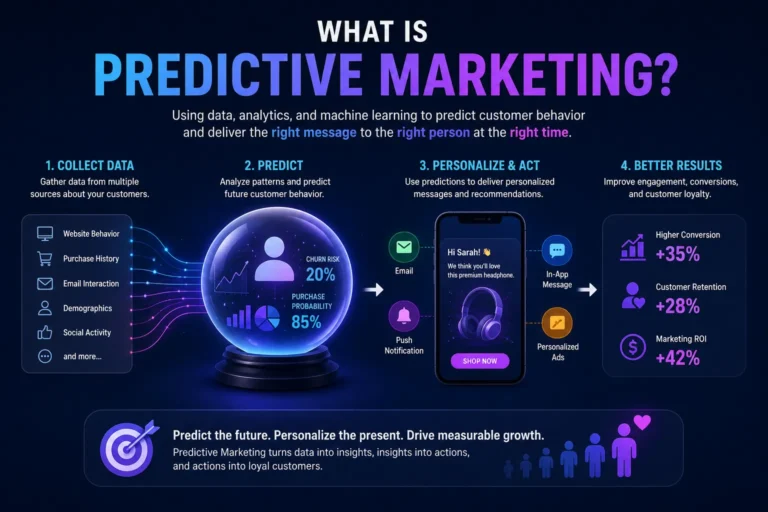
Predictive marketing uses past data and AI to forecast future customer behaviour. It helps brands understand what a customer is likely to do next: buy, leave, click, or ignore.
Instead of reacting to what customers do, businesses can now act before the customer makes a move.
A simple example:
If a customer adds a product to their cart but doesn’t buy, predictive tools can send them a personalised discount within minutes. The system knows this customer’s behaviour and predicts they need a small push.
Predictive marketing combines:
◉ Customer data (past purchases, browsing history, location)
◉ Machine learning models (algorithms that learn from patterns)
◉ Marketing automation (tools that take action automatically)
The result? Smarter campaigns, better targeting, and higher returns.
Why Predictive Marketing Is Growing Fast
Three forces are driving the rise of predictive marketing:
① More data than ever before
Every click, scroll, search, and purchase creates data. Businesses now collect billions of data points every day. This data is the fuel for predictive marketing.
② Cheaper AI tools
Just a few years ago, AI-powered marketing tools were only for large companies. Today, tools like HubSpot, Salesforce Einstein, and Google’s AI suite are accessible to small and mid-sized businesses.
③ Rising customer expectations
Customers now expect brands to know them. They want relevant offers, not random ads. Predictive marketing makes personalisation possible at scale.
According to McKinsey, companies that use data-driven marketing are six times more likely to be profitable year-over-year. That number alone explains why predictive marketing is growing so fast.
How Predictive Marketing Works
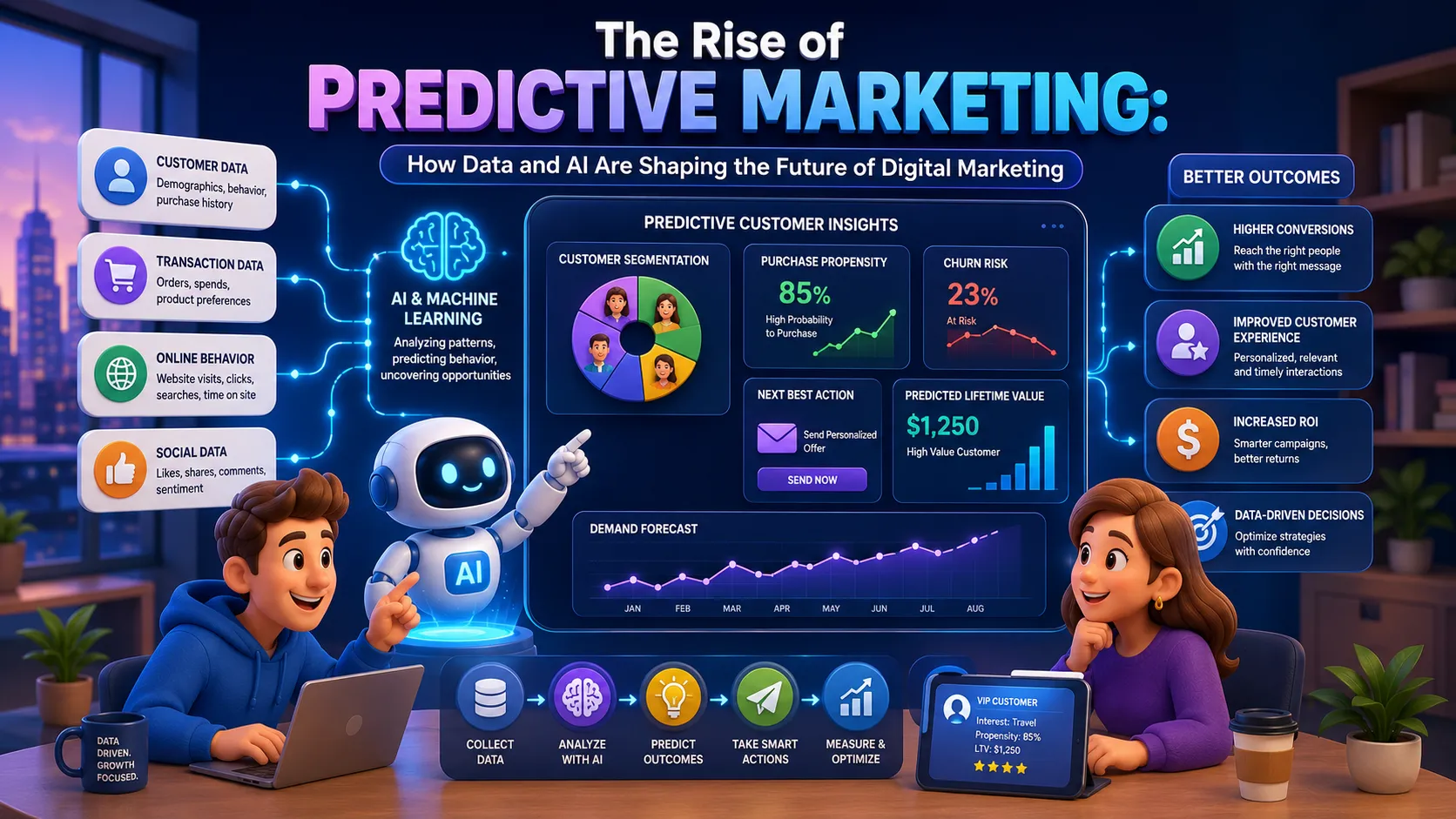
Predictive marketing is not magic. It follows a clear process. Here is how it works, step by step.
Data Collection
Everything starts with data. Marketers collect data from many sources:
Website behavior (pages visited, time on site, clicks)
⦿ CRM systems (customer purchase history, service interactions)
⦿ Social media activity (likes, comments, follows)
⦿ Email engagement (open rates, click rates)
⦿ Third-party data (demographic information, market research)
The more quality data you collect, the better your predictions will be. This is why data hygiene – keeping your data clean and organised – matters so much.
Customer Behavior Analysis
Once you have data, you analyse it to find patterns. You look at what customers did in the past to predict what they will do next.
Behaviour analysis answers questions like:
⦿ Which customers are likely to buy again in the next 30 days?
⦿ Which customers are at risk of leaving?
⦿ What product is a first-time buyer most likely to purchase next?
Tools like Google Analytics 4, Mixpanel, and Adobe Analytics help marketers map the full customer journey and identify patterns that human eyes would miss.
Machine Learning Models
This is where AI steps in. Machine learning models process thousands of data points and find connections humans cannot spot manually.
There are several types of models used in predictive marketing:
⦿ Propensity models — predict the likelihood of a specific action (purchase, churn, upgrade)
⦿ Segmentation models — group customers by shared behaviors or traits
⦿ Lifetime value models — predict how much revenue a customer will generate over time
⦿ Recommendation models — suggest the next best product, content, or offer
These models improve over time. The more data they process, the more accurate they become.
Automated Decision Making
The final step is action. Once a model makes a prediction, marketing automation tools take over.
If a model predicts that a customer is likely to churn, the system automatically triggers a retention email. If a model predicts a customer is ready to buy, it serves them a personalised ad.
This entire process can happen in real time without any human involvement. That is the power of marketing automation combined with predictive intelligence.
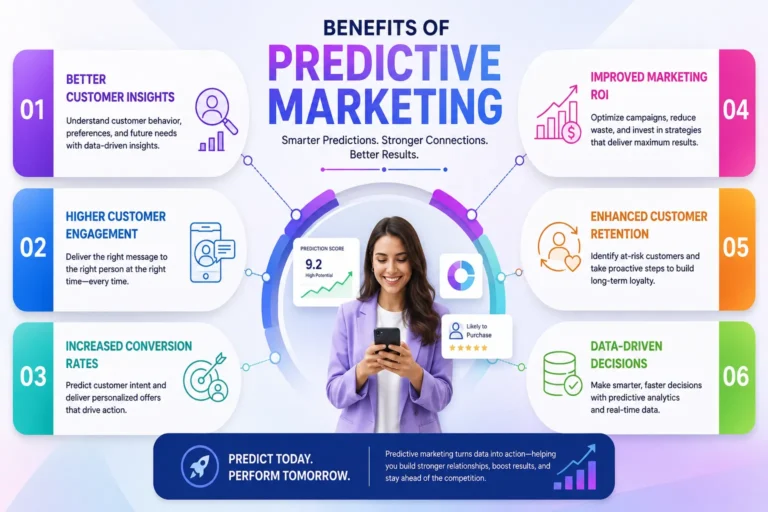
Why are so many businesses investing in predictive marketing? Here are the four biggest benefits.
Better Customer Targeting
Traditional marketing targets broad audiences. Predictive marketing targets the right people at the right time.
Instead of showing an ad to 10,000 random people, you show it to 1,000 high-intent customers who are likely to convert. Your budget works harder. Your results improve.
Higher Conversions
When your message matches what the customer needs, conversions go up. Predictive marketing makes sure every message feels relevant.
Brands like Amazon report that up to 35% of their revenue comes from predictive product recommendations alone. That is the direct impact of prediction on conversion rates.
Improved Customer Experience
Customers do not want to feel marketed to. They want to feel understood.
Predictive marketing creates experiences that feel personal and helpful, not intrusive. When done right, customers appreciate the brands that seem to “know” them.
Better ROI
When you stop wasting budget on audiences that will never convert, your ROI improves dramatically.
Predictive marketing helps you allocate budget more efficiently, spending more where the data says it will deliver results and pulling back where it won’t.
Real-World Examples of Predictive Marketing
Let’s look at how real companies use predictive marketing today.
Netflix uses machine learning to predict which shows you will enjoy. Its recommendation engine drives over 80% of all content watched on the platform. Without predictive marketing, Netflix would need to spend millions more on promotion to get the same views.
Spotify predicts what music you want to hear next. Its “Discover Weekly” playlist uses behaviour data from 400 million users to create personalised playlists. Users love it, and it keeps them on the platform longer.
Amazon predicts what you will buy before you search for it. Its “anticipatory shipping” model even begins preparing shipments before a customer places an order, based on browsing behaviour and past purchases.
Starbucks uses predictive analytics through its loyalty app. It sends personalised drink recommendations based on weather, time of day, and past orders. This drives a significant portion of its loyalty revenue.
These are not just big-brand tactics. The same principles – data, prediction, and automation – are available to small businesses and marketers through affordable tools today.
Predictive Marketing vs. Traditional Marketing
Factor | Traditional Marketing | Predictive Marketing |
|---|---|---|
Audience Targeting | Broad, demographic-based | Precise, behavior-based |
Decision Making | Human intuition | Data and AI models |
Campaign Timing | Scheduled in advance | Real-time and dynamic |
Personalization | Limited or manual | Automated and scalable |
Budget Efficiency | Often wasteful | Optimized for ROI |
Speed | Slow to adjust | Adapts instantly |
Traditional marketing still has a place, especially in brand building. But when it comes to conversion and efficiency, predictive marketing wins every time.
Why Marketers Need Data Skills
Predictive marketing is not just a technology shift. It is a skill shift.
The most valuable marketers in 2025 and beyond will be those who can:
Understand and interpret data
⦿ Work with AI tools to build campaigns
⦿ Analyze customer behavior and customer journey maps
⦿ Optimize campaigns using marketing analytics
⦿ Run effective paid campaigns on Google and Meta using data signals
These are learnable skills. You do not need a computer science degree to work with predictive marketing tools. What you need is structured learning and practice.
Many professionals in Surat are already building these skills through focused programmes. A quality digital marketing course in Surat that blends strategy, analytics, AI tools, SEO, and paid advertising gives you a complete foundation.
When you understand how to collect data, analyse behaviour, and use AI to automate decisions, you become the kind of marketer every company wants to hire or the kind of business owner who can compete with brands ten times your size.
Conclusion
Predictive marketing is no longer optional. It is the direction every industry is moving.
Brands that use data and AI to predict customer behaviour will outperform those that do not. They will spend less, convert more, and build deeper customer loyalty.
The good news is that you do not need to be a data scientist to benefit from predictive marketing. With the right tools and the right skills, any marketer can apply these principles.
If you are serious about a career in modern digital marketing, look for a digital marketing course in Surat that goes beyond the basics, one that teaches you AI tools, marketing analytics, customer behaviour analysis, and data-driven strategy.
The future of marketing belongs to those who can predict it. Start building that skill set today.