- Written by: SimbaHardik
- June 8, 2026
- Categories: Blog
- Tags:
Introduction
Think about the last time you Googled something important. Chances are, a bold AI-generated summary appeared right at the top before any blue links. That is the Google AI Overview, and it is completely reshaping how people find information online.
If your content is not showing up in those AI-powered summaries, you are already losing traffic to competitors who figured this out. Whether you run a business, a blog, or you are enrolled in a digital marketing course in Surat, understanding how to rank in the Google AI Overview is now a non-negotiable skill.
This guide breaks everything down in a way that actually makes sense, even if you are starting from scratch.
What Is a Google AI Overview and Why Does It Matter?
The Google AI Overview is an AI-generated response that appears at the very top of search results. It pulls information from multiple trusted sources and presents a summarized answer to the user’s query.
Google launched this feature as part of its Search Generative Experience (SGE). The goal is to give users faster, more comprehensive answers without requiring them to click through multiple websites.
Here is why this matters for you:
• Websites featured in AI Overviews receive massive visibility boosts
• Users trust these summaries because Google’s AI curates them carefully
• Brands appearing here are seen as authoritative sources in their niche
• Organic click-through rates improve significantly for cited sources
Missing out on this feature means your competitors are building trust with your potential audience every single day.
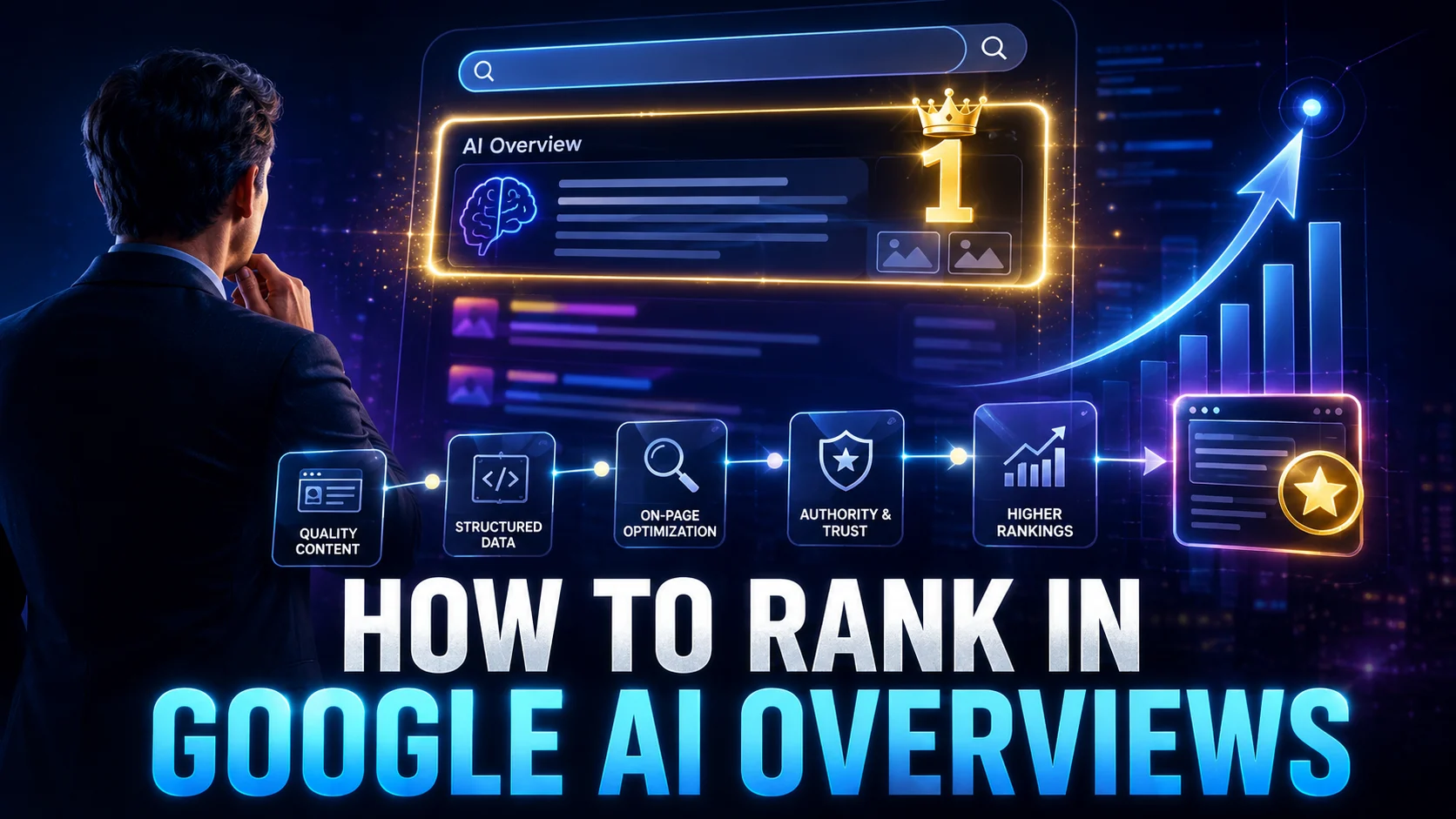
Step-by-Step Guide to Ranking in Google AI Overviews
Step 1: Write Content That Directly Answers Questions
The Google AI Overview is built to satisfy search intent instantly. So your content must answer questions clearly, quickly, and completely.
Use question-based headers like “What is,” “How to,” or “Why does.” Structure your content so Google’s AI can extract the exact answer without confusion. Think of it like writing for a featured snippet, but with more depth and context.
Avoid burying your answers inside long, rambling introductions. Get to the point fast.
Step 2: Build Topical Authority in Your Niche
Google’s AI rewards websites that demonstrate deep expertise across a specific topic. If your blog only has two or three posts, you are unlikely to be picked up by the AI overview system.
Create a content cluster strategy. Write pillar posts on broad topics and support them with detailed subtopic articles. For example, if your niche is digital marketing, cover everything from SEO basics to social media ads to email automation.
The more comprehensively you cover a subject, the more Google treats you as an authority worth citing.
Step 3: Optimize for E-E-A-T (Experience, Expertise, Authoritativeness, Trust)
This is not just an SEO buzzword. E-E-A-T is the foundation. Google’s quality raters use to evaluate your content before the AI ever picks it up.
Here is how to strengthen each pillar:
• Experience: Share first hand knowledge, real case studies, and personal insights
• Expertise: Include author bios, credentials, and professional backgrounds
• Authoritativeness: Get cited by reputable websites and earn quality backlinks
• Trust: Use HTTPS, have a clear privacy policy, and maintain consistent content quality
A student completing a digital marketing course in Surat who applies these principles from day one will build a website that Google genuinely respects.
Step 4: Use Structured Data and Schema Markup
Google’s AI crawlers love structured data because it tells them exactly what your content is about. Adding schema markup like FAQ schema, How-To schema, and Article schema helps Google categorize your information accurately.
This increases the likelihood that your content gets pulled into an AI overview. It is a technical step, but most WordPress SEO plugins like Rank Math or Yoast make it straightforward to implement.
Step 5: Focus on Conversational and Long-Tail Keywords
AI overviews tend to appear for conversational, question-based searches. Think about how real people actually speak, not how old-school SEO writers used to stuff keywords.
Target phrases like “how do I,” “what is the best way to,” and “can you explain.” These conversational triggers align directly with the queries that activate Google AI Overview responses. Use tools like Google’s People Also Ask section to discover exactly what your audience is searching for.
Step 6: Keep Your Content Fresh and Updated
Google’s AI prefers recent, relevant information. A blog post written in 2020 without updates is unlikely to compete with content refreshed this year.
Set a content audit schedule. Review your top-performing posts every three to six months. Add new statistics, update outdated advice, and expand thin sections with fresh insights.
Fresh content signals to Google that your website is actively maintained and trustworthy.
Common Beginner Mistakes That Kill Your Chances
Many new bloggers and marketers make the same avoidable errors when trying to rank in the Google AI Overview. Here are the most critical ones to stop doing immediately.
Writing for search engines instead of humans – Keyword-stuffed, robotic content rarely gets featured. The AI is trained to identify genuine helpfulness, so write like a knowledgeable friend explaining something clearly.
Ignoring page experience signals – If your website loads slowly, is hard to navigate on mobile, or has intrusive popups, Google will deprioritize your content regardless of how good the writing is.
Skipping internal linking – Connecting your related posts helps Google understand your site structure and boosts the overall authority of every page you publish.
Not building backlinks – External sites linking to your content are votes of confidence. Even a few high-quality backlinks from respected industry websites can dramatically improve your chances of appearing in AI summaries.
Skills You Need to Win at AI Overview SEO
Ranking in the Google AI Overview is not just about writing. It requires a blend of technical and creative skills that modern digital marketers need to master.
Here is a practical roadmap for skill building:
Content Strategy: Learn how to plan, structure, and publish content that serves real search intent. This is the foundation of everything.
On-Page SEO: Understand how to optimize titles, meta descriptions, headers, image alt text, and internal links on every post you publish.
Technical SEO: Learn about site speed, Core Web Vitals, schema markup, and mobile optimization. These technical factors influence whether Google’s AI considers your site reliable.
Analytics and Data: Use Google Search Console and Google Analytics to track what is working. Data driven decisions separate the marketers who grow from those who guess.
If you are based in Gujarat and want to build these skills systematically, enrolling in a digital marketing course in Surat can give you structured mentorship, real-world projects, and industry-recognized certification that accelerates your career significantly.
Career and Salary Opportunities in AI-Driven SEO
The demand for SEO specialists who understand AI search is growing faster than ever. Businesses across every industry are scrambling to adapt their digital strategies to the new AI-powered search landscape.
Here is what the career growth looks like:
• Entry Level SEO Analyst: Starting salaries range from 2.5 to 4 LPA in India, with strong growth potential within 12 to 18 months
• Content Strategist: Mid-level roles command 5 to 9 LPA depending on niche expertise and portfolio strength
• SEO Manager or Consultant: Senior professionals with AI SEO skills are earning 10 to 20 LPA and beyond, especially in agencies and tech companies
The professionals who invest in learning AI overview optimization now will have a significant competitive advantage over the next five years. This is not a trend. It is a permanent shift in how digital marketing works.
Conclusion
The Google AI Overview is not going away. It is getting smarter, more personalized, and more influential with every passing month. The websites that adapt to this reality now will dominate their niches while others struggle to catch up.
Start by auditing your existing content for clarity, depth, and E-E-A-T signals. Then build out your topical authority with structured, well-researched content that genuinely helps your audience. Add schema markup, refresh your old posts, and focus relentlessly on answering real questions better than anyone else in your space.
If you are ready to fast track your learning and build a real career in modern SEO and digital marketing, consider enrolling in a digital marketing course in Surat where you can learn everything from content strategy to technical SEO under expert guidance.
The best time to start was yesterday. The second best time is right now.
Ready to future-proof your digital marketing career? Take the first step today and start learning the skills that actually get results in 2025 and beyond.
FAQs
Q1: What exactly is a Google AI Overview?
A Google AI Overview is an AI-generated summary that appears at the top of Google search results, pulling information from multiple trusted sources to directly answer a user’s query.
Q2: Can any website rank in Google AI Overviews?
Yes, any website can potentially be featured, but your content must demonstrate clear expertise, strong E-E-A-T signals, and be well structured so Google’s AI can easily extract relevant answers.
Q3: How long does it take to appear in Google AI Overviews?
There is no fixed timeline. Some optimized content appears within weeks while others take months. Consistently publishing high-quality, authoritative content is the most reliable path.
Q4: Does social media activity help with AI overview rankings?
Social signals are not a direct ranking factor, but content that gets shared widely tends to earn more backlinks and visibility, which indirectly strengthens your chances of being featured.
Q5: Is a digital marketing course in Surat worth it for learning SEO?
Absolutely. A structured course gives you hands-on experience, mentorship, and a portfolio that generic online tutorials simply cannot provide. It significantly shortens your learning curve.
Q6: Do I need technical knowledge to optimize for Google AI Overviews?
Basic technical knowledge helps, especially for schema markup and site speed. However, even nontechnical bloggers can make significant progress by focusing on content quality and structure first.