- Written by: yashjetani08@gmail.com
- June 3, 2026
- Categories: Blog
- Tags:
Introduction
Think about how you searched for something five years ago — keywords into Google, ten blue links, click and read.
Now think about what millions of people do today. They open ChatGPT or Perplexity and ask a full question like they’d ask a knowledgeable colleague. Within seconds, they get a complete, conversational answer. No scrolling. No clicking.
Here is the problem: your brand either appears inside that AI-generated answer — or it is completely invisible to that user.
Ranking on Google no longer guarantees visibility in AI search. These are two different games, and most businesses are only playing one. The discipline that governs AI search visibility is called Generative Engine Optimization — GEO — and this guide breaks it down from first principles to practical strategy.
What is GEO — Generative Engine Optimization?
Generative Engine Optimization (GEO) is the practice of creating, structuring, and publishing content so that AI-powered answer platforms cite your brand when constructing their responses to user questions.
Platforms like ChatGPT, Perplexity, Google AI Overviews, Microsoft Copilot, and Gemini do not return ranked lists of links when a user asks a question. They generate a direct, paragraph-form answer — and they build that answer by drawing from content they have evaluated as credible, well-structured, and authoritative.
GEO is the strategy of becoming one of the sources those platforms trust and cite.
Here is the core distinction:
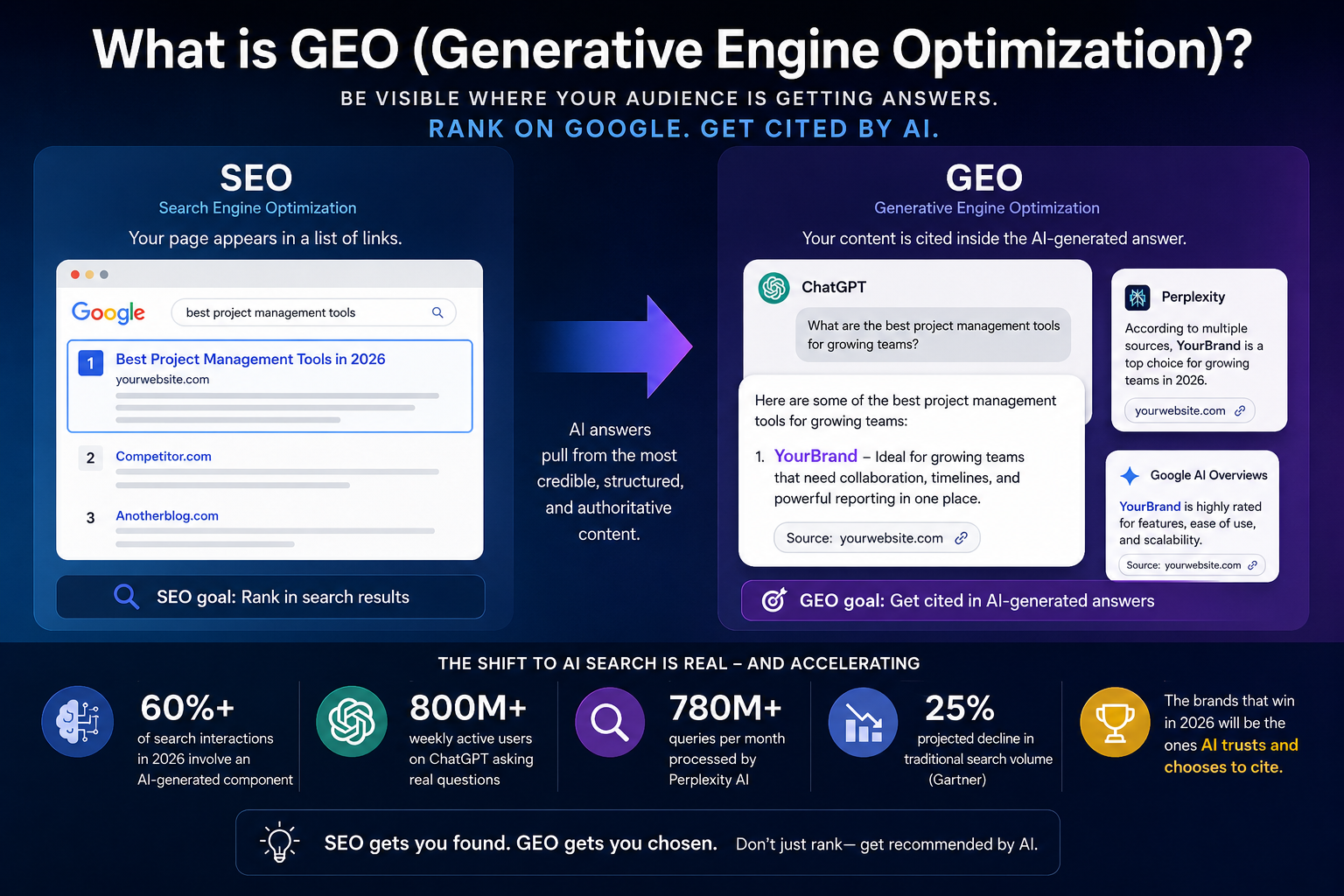
● SEO places your page in Google’s ranked list of results
● GEO places your content inside the AI’s generated answer itself
A page can rank number one on Google and never once appear in an AI response. A different page on the same subject — more structured, more authoritative, richer in verified data — can rank on page three of Google and get cited by AI dozens of times a day.
This is why GEO deserves its own dedicated strategy, separate from traditional search engine optimization.
Why GEO Matters More Than Ever in 2026
The scale of the shift toward AI search is no longer a projection — it is a measurable reality.
● Over 60% of all search interactions in 2026 now involve an AI-generated component
●ChatGPT serves more than 800 million weekly active users asking genuine consumer and business questions
●Perplexity AI processes close to 780 million queries every month — and that number keeps climbing
●Gartner research projects a 25% decline in traditional search volume as users increasingly prefer direct AI answers over scrolling through links
These are not small numbers. This is a big shift in how people find information
The Visibility Problem Most Businesses Are Missing
Your customers are asking AI tools questions right now.
They ask things like:
● “Which brand should I buy?”
● “Which service is the best?”
● “What works best for my problem?”
They get a full answer back in seconds.
If your brand is not in that answer — you are invisible to that customer at that moment.
● Good SEO alone will not fix this
● A competitor with weaker Google rankings can still dominate AI answers
● Every month you wait, your competitors get stronger in AI search
GEO vs SEO — What is the Difference?
Many people in digital marketing mix up these two terms. They are not the same thing. Let’s break it down simply.
SEO — Search Engine Optimization
SEO helps your web pages rank higher on Google and Bing.
When someone types a keyword into Google, good SEO helps your page appear near the top of the results.
The main parts of SEO are:
● Using the right keywords on your page
● Getting links from other trusted websites
● Writing good, in-depth content
● Making sure your website loads fast on mobile
● Fixing technical issues on your site
Winning with SEO looks like: Your page shows up at the top of Google when someone searches for your topic.
GEO — Generative Engine Optimization
GEO is different. It is not about Google rankings. It is about getting your content mentioned inside AI answers.
When someone asks ChatGPT a question, the AI builds a full response from scratch. It reads content from across the web and picks the most trusted, well-written sources. Your job with GEO is to be one of those sources.
Winning with GEO looks like: Your brand name or your article shows up inside a ChatGPT or Perplexity answer when someone asks about your topic.
SEO and GEO work best together. SEO builds your base. GEO takes your content into AI answers. A smart digital marketing plan in 2026 uses both.
How Does AI Decide What Content to Use?
This is the most useful thing to understand about GEO.
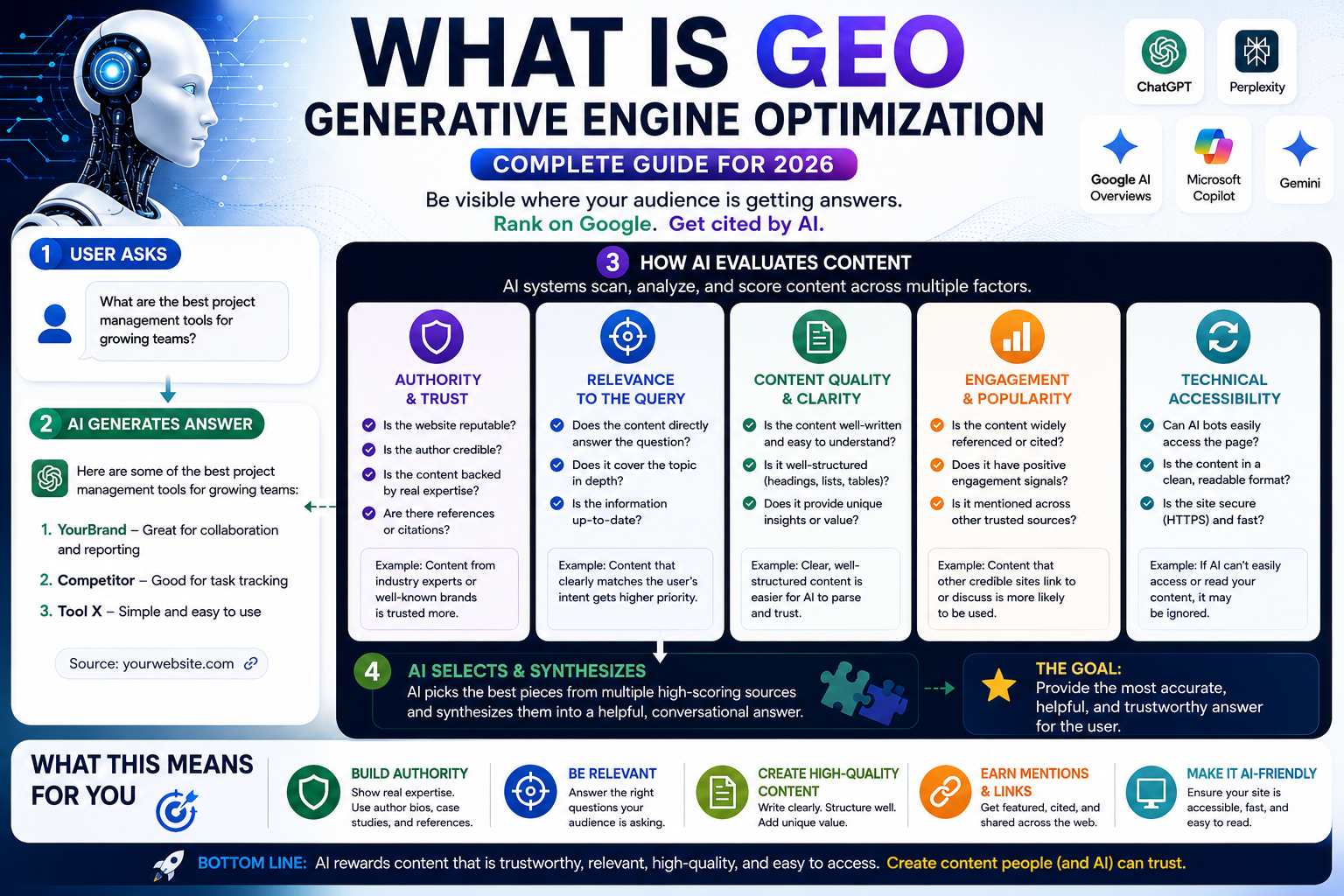
AI tools do not just pick random content. They look for content that passes a quality check. Here is what they look for.
5 Things AI Looks for in Good Content
● A real author — Content written by a named, real expert gets more trust. Anonymous content gets less.
● Clear structure — AI tools read heading levels, bullet points, and short paragraphs. Messy walls of text get skipped.
● Real facts and numbers — Vague writing gets ignored. Specific stats, studies, and examples get picked up.
● Full topic coverage — A post that answers one part of a question loses to a post that answers all parts.
● Fresh content — Old pages that have not been updated lose their spot over time. Fresh pages stay relevant.
How E-E-A-T Connects SEO and GEO
Google has a quality framework called E-E-A-T. It stands for Experience, Expertise, Authoritativeness, and Trustworthiness.
This was built for SEO — but it now affects GEO too.
AI tools trust websites that Google already trusts. So a strong SEO track record helps your GEO results as well. If your SEO is weak, your GEO will be harder to build. If your SEO is strong, GEO becomes much easier.
The two strategies are connected at the root.
How to Build a GEO Strategy — 6 Simple Steps
Here is a clear, practical plan anyone can follow to start winning in AI search.
Step 1 — Own a Topic, Not Just a Keyword
Old SEO thinking was: pick a keyword and write one article.
GEO thinking is different: own the whole topic.
AI-tools trust websites that cover a subject deeply — not websites with one good article on it. You need to build a full content library around your topic.
How to do it:
● Pick two or three topics you know really well
● Write one big, detailed guide for each topic — cover every angle and every question
● Write smaller supporting articles around each big guide
●Link all the articles together
● Update them every few months to keep them fresh
This kind of content library tells AI: this website is the expert on this topic.
Step 2 — Format Your Content So AI Can Read It Easily
AI tools scan content differently from humans. If your content is hard to scan, AI will skip it and use something easier.
Simple rules to follow:
● Answer the main question in the first 100 words — do not wait
● Use clear headings at every section — H1, H2, H3 with keywords
● Keep paragraphs short — 2 to 3 sentences only
● Use bullet points for lists
● End every long article with a FAQ section
● Add schema markup to your pages — Article, FAQ, HowTo, and Person schema
Step 3 — Give AI Something to Quote
AI tools look for sentences they can pull out and use. Your content needs to have lots of those.
How to write more quotable content:
● Use real research data — your own surveys or trusted industry stats
● Support every claim with a number or a source
● Write clear, direct sentences that make sense on their own
● Use real examples to explain hard ideas
● State conclusions clearly — do not leave readers guessing
Step 4 — Write the Way People Actually Talk
People do not type keywords into ChatGPT. They ask real questions like:
“What is the best way to market my business online?” “How does GEO work and why do I need it?”
Your content needs to match that natural, conversational style.
Simple ways to do this:
● Answer the question directly at the start of each article
● Use phrases like “how does,” “what is,” and “why should” throughout
● Explain every technical word right away in plain language
● Think about what follow-up question a reader might have — and answer it in the same article
Step 5 — Build Your Brand Across the Web
AI tools do not just look at your website. They look at your whole online presence.
A brand that shows up in many trusted places online gets more AI citations than a brand that only has a website.
Ways to build your presence:
● Write articles on LinkedIn and Medium
● Guest post on trusted blogs in your field
● Answer questions on Quora and Reddit — be helpful, not promotional
● Try to get mentioned in news articles and industry reports
● Keep your Google Business Profile updated with fresh posts and real reviews
Step 6 — Track What AI Says About Your Brand
Most businesses track Google rankings. Very few track what AI tools say about them.
That is a missed opportunity.
Simple ways to track your GEO performance:
● Every week, go to ChatGPT and Perplexity and ask 10 questions about your topic
● Write down if your brand appears and how it is described
● Check Google Analytics 4 for traffic coming from AI referrals
●Watch your branded search volume each month — if it rises, your AI presence is growing
●Use what you find to fill content gaps and improve your strategy
4 Common GEO Mistakes to Avoid
Mistake 1 — Thinking GEO and SEO Are the Same Thing
They are not.
SEO rewards keywords, links, and technical setup. GEO rewards real expertise, clear structure, and content that AI can trust and use. If you try to use your old SEO content plan for GEO, it will not work. You need a fresh approach.
Mistake 2 — Writing Lots of Short, Thin Content
Posting 20 short articles is not better than posting 4 deep ones.
AI tools almost always pick deep, complete content over short, surface-level posts.
Watch out for these warning signs:
● Articles under 800 words on big topics
● Posts that list tips without explaining why they work
● Content that has not been updated in over 6 months
● Pages with no named author and no real data
Mistake 3 — Only Publishing on Your Own Website
If you only publish on your own site, AI tools have a limited view of your brand.
They trust brands they see in many different trusted places online. Start getting your content and name out there — on other platforms, in the news, in community discussions.
Mistake 4 — Doing GEO Once and Forgetting It
AI tools update and change all the time. Brands that keep publishing, updating, and checking their AI presence stay visible. Brands that stop lose ground fast.
GEO is not a project you finish. It is something you keep doing.
Technical GEO — What to Set Up on Your Website
Good content is not enough on its own. Your website also needs some technical setup to help AI tools read it properly.
Schema Markup — Help AI Understand Your Pages
Schema markup is a type of code you add to your website. It helps both Google and AI tools understand what your content is about.
The most useful schema types for GEO:
● Article Schema — tells AI who wrote the article and when
● FAQ Schema — makes your questions and answers easy for AI to pull out
● How To Schema — marks your step-by-step guides clearly
● Person Schema — confirms that your author is a real, named expert
●Organization Schema — tells AI who your brand is and what you do
The llms.txt File — A New Tool for GEO in 2026
In 2026, a new file standard was introduced called llms.txt.
Think of it like robots.txt — but for AI tools instead of Google crawlers. It tells AI reading systems how to access and use your content.
Technical steps to get your site GEO-ready:
● Add an llms.txt file to your website’s root folder
● Make your website load fast — slow sites get skipped by AI crawlers too
● Use clean, simple HTML with proper heading levels on every page
● Make sure your main content loads without needing JavaScript
● Keep your sitemap up to date so AI tools find new pages quickly
GEO — Frequently Asked Questions
What does GEO stand for?
GEO stands for Generative Engine Optimization. It means making your content good enough that AI tools like ChatGPT and Perplexity use it when they answer user questions.
Does GEO replace SEO?
No. GEO does not replace SEO — it builds on top of it. You still need strong search engine optimization to rank on Google. But you also need GEO to show up in AI answers. Both matter in 2026.
Which AI platforms does GEO target?
GEO works across all major AI answer tools: ChatGPT, Perplexity AI, Google AI Overviews, Google Gemini, Microsoft Copilot, and Claude by Anthropic.
How long does GEO take to work?
Technical changes can start showing results in 3 to 5 weeks. Consistent AI citations usually start appearing after 2 to 4 months of steady work. The earlier you start, the better — because GEO authority builds up over time.
What kind of content works best for GEO?
The content that gets cited most by AI tools includes:
● Detailed how-to guides
● Clear definition articles that explain what something is
● Comparison posts that weigh two options against each other
● Articles with real data and research
● FAQ pages that answer common questions clearly
Conclusion: Start Now — The Window is Still Open
GEO is not coming in the future. It is here right now. And it is already deciding which brands people find — and which brands they never see.
Businesses that start building GEO authority today are getting ahead fast. The longer you wait, the harder it gets to catch up.
Think about it this way. Right now, someone is asking ChatGPT about a product or service in your industry. The AI is giving them a confident answer. Is your brand in that answer? Or is your competitor?
That question is worth acting on today.
Here is what to do this week:
● Check your best content — is it structured for AI to read easily?
● Pick your top 2 or 3 topics and start building deep content around them
● Add schema markup to your most important pages
● Create an llms.txt file for your website
● Go to ChatGPT and Perplexity right now and search for your topic — see what comes up
● Look at which competitors appear in those answers — and study what they are doing right
You do not need to be the biggest brand to win at GEO. You do not need the biggest budget either.
You just need to be the most helpful, most trusted, and best-structured voice on your topic. That is something any brand can build — with the right content strategy and a little patience.