- Written by: SimbaHardik
- June 2, 2026
- Categories: Blog
- Tags:
Introduction
Search is changing faster than ever.
Just a few years ago, people typed a few words into Google and clicked a website. Today, AI tools can answer questions in seconds. Users now get direct answers from Google AI Overviews, ChatGPT Search, and Perplexity AI.
Many experts believe that AI-powered search will handle a large share of online searches by 2030.
This change creates a big question:
What happens to SEO in an AI-powered world?
The good news is simple.
SEO is not dying.
SEO is evolving.
Businesses still need visibility. Websites still need traffic. Brands still need trust. Content still needs to answer real questions.
The difference is that AI now plays a major role in how people find information.
This shift creates new opportunities for students, marketers, business owners, and content creators.
If you want to stay ahead, learning modern SEO through a digital marketing course in Surat can help you build future-ready skills.
In this guide, you will learn:
- How AI-powered search works
- Why traditional SEO is changing
- What Generative Engine Optimization (GEO) means
- New ranking factors in 2026
- Future SEO skills that matter
- How businesses can win in AI Search
What Is AI-Powered Search?
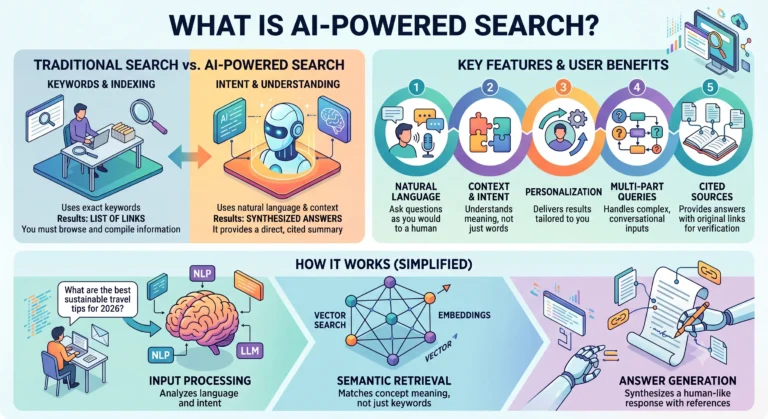
AI-powered search uses artificial intelligence to understand questions and provide direct answers.
Instead of showing only links, AI search engines try to understand the user’s intent.
They then generate useful responses.
Popular AI search platforms include:
- Google AI Overviews
- ChatGPT Search
- Perplexity AI
- Microsoft Copilot
These tools make search more conversational.
People now search like they talk.
For example:
Old search:
“best SEO tools”
New search:
“What are the best SEO tools for a small business with a limited budget?”
AI understands both the question and the context.
That changes everything.
Google AI Overviews
Google now provides AI-generated summaries for many searches.
Users often see answers before clicking any website.
This means websites must provide clear, trusted, and useful information if they want to appear in AI-generated results.
Action Tip
Create content that answers questions directly.
Use simple language.
Add clear headings and structured content.
ChatGPT Search
ChatGPT Search gives users direct answers from multiple sources.
Many users now ask detailed questions instead of typing short keywords.
This creates a new challenge for marketers.
Your content must be useful enough for AI systems to reference it.
Action Tip
Focus on complete answers instead of keyword stuffing.
Perplexity AI
Perplexity AI combines AI answers with source citations.
Users can quickly verify information.
This increases the value of trustworthy content.
Action Tip
Publish expert content backed by facts and real experience.
What Is Generative Engine Optimization (GEO)?
Generative Engine Optimization (GEO) is the next evolution of SEO.
It focuses on helping AI systems find, understand, and reference your content.
Traditional SEO helps pages rank.
GEO helps content appear in AI-generated answers.
GEO vs Traditional SEO
Traditional SEO | GEO |
Focus on rankings | Focus on AI citations |
Keyword-focused | Context-focused |
Search results | AI-generated answers |
Clicks | Visibility and mentions |
SERP optimization | AI optimization |
Benefits of GEO
- Greater AI visibility
- More brand mentions
- Increased trust
- Better authority signals
- Future-proof marketing strategy
Why GEO Matters
AI search adoption continues to grow.
Businesses that optimize for GEO today will gain a competitive advantage tomorrow.
(Content continues with Strategies to Win in AI Search, SEO Mistakes, Case Studies, Future Predictions, Skills for SEO Careers, Conclusion, FAQs, and Simba Institute CTA.)