 Introduction: That Purchase You Regret? It Wasn’t Fully Your Choice.
You opened your phone to buy just one thing. But within minutes, your cart was full, you clicked “Buy Now”, and somehow ended up subscribing to something you never planned for.
Today’s biggest brands invest billions of dollars in understanding consumer psychology. They study what grabs your attention, creates urgency, triggers fear of missing out, and pushes you to act quickly. These strategies, often called dark marketing tactics, are designed to quietly influence your behaviour while making you believe the choice was entirely yours.
From fake urgency and hidden subscriptions to manipulative discounts and endless notifications, these tactics are everywhere in the digital world. In this blog, we’ll uncover how these strategies work, why they are so effective, and how brands use them every day to influence consumers. Most importantly, you’ll learn how to recognise these tricks and make smarter, more conscious decisions online.
Let’s pull back the curtain and expose the psychology behind modern marketing.
What Are Dark Marketing Tactics?
Dark marketing tactics are strategies that brands use to influence your buying decisions in ways that are misleading, manipulative, or unfair.
They are not always illegal. But they are almost always sneaky.
The realised simple: make you buy more, buy faster, or buy things you didn’t need — all without you realising what’s happening.
These tactics show up everywhere:
- E-commerce websites like Amazon and Flipkart
- Social media ads on Instagram, Facebook, and YouTube
- Subscription apps and streaming services
- Email campaigns and push notifications
Now let’s look at the most common ones one by one.
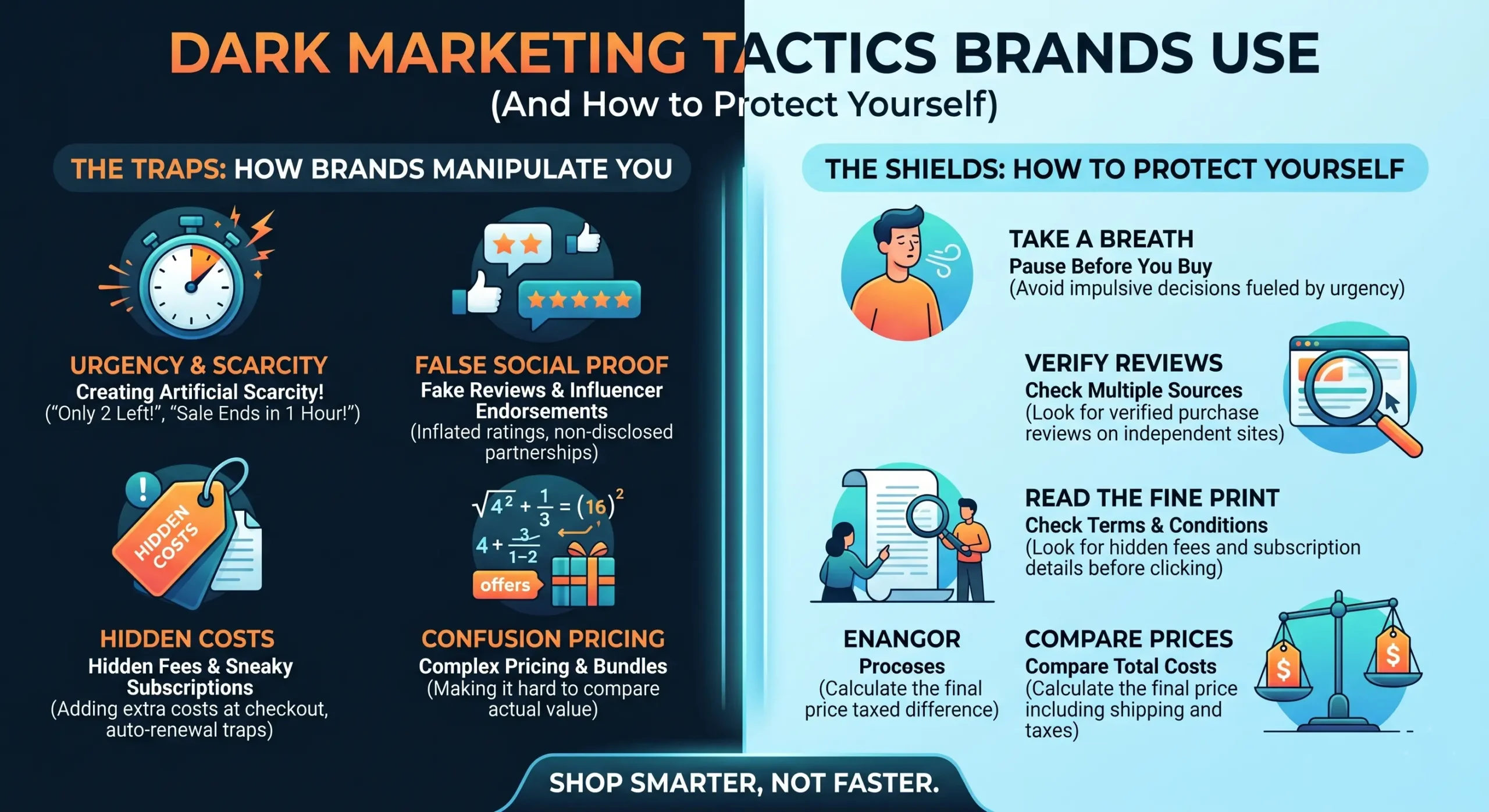
1. The Fake Countdown Timer
Have you ever seen something like this?
“Offer ends in 00:12:34! Only 3 left in stock!”
Your heart speeds up. You think, ‘I have to buy this NOW or I’ll miss out.’
That feeling is called ‘FOMO’, the fear of missing out. And brands weaponise it constantly.
Here’s the dirty secret: many of those countdown timers reset the moment you refresh the page. The “3 left in stock” message might be a lie. Some tools even show fewer items left when more people are viewing the page just to create panic.
Amazon has been caught doing this. So has every major fashion brand that runs “flash sales” every single weekend.
How to protect yourself: Refresh the page. Wait a day. If the “sale” is still running, it was never a real deadline.
2. The Confusing Unsubscribe Trap
You sign up for a free trial. It’s easy – just a few clicks.
But when you try to cancel? It’s a maze.
Companies like gyms, streaming apps, and SaaS tools do this on purpose. The “cancel” button is buried under five menus. You have to call a phone number that’s only open on weekdays. Or you find out you had to cancel 30 days before the renewal date.
This is called a roach motel: easy to get in, nearly impossible to get out.
Real Example: A popular US gym chain was fined by the FTC in 2024 for making cancellations deliberately difficult. The same pattern exists in many Indian subscription apps today.
How to protect yourself: Before signing up for any free trial, Google “[Brand Name] + how to cancel”. If it’s complicated, skip it.
3. Hidden Fees That Appear at the Last Second
You pick a flight ticket for ₹2,499. You go through the booking process. You add your luggage, pick your seat, and then right before payment the price becomes ₹4,800.
Baggage fees. Seat selection charges. A “convenience fee”. A “platform fee”.
This is called drip pricing. Brands show you a low price to get you interested, then slowly reveal the real cost at the very end when you’ve already invested time and effort.
The psychology behind it: By the time you see the real price, you’re already committed. You feel like you’ve wasted all that time if you go back now. So you just pay.
Airlines do this. Food delivery apps do this. Online course platforms do it too.
How to protect yourself: Always scroll to the final checkout page before you decide. Use browser extensions like Honey or CamelCamelCamel to track real pricing history.
4. Dark Patterns in Design (The Sneaky UI Tricks)
This is one of the most fascinating and frustrating dark tactics.
Companies design their websites and apps to trick your eyes. Here are some examples:
- Confirm-shaming: Instead of “No thanks”, the decline button says, “No, I don’t want to save money.” It makes you feel guilty for saying no.
- Pre-ticked boxes: Newsletter subscriptions, marketing emails, or add-on purchases are already selected for you by default. You have to opt out instead of opt in.
- Misdirection: The “Cancel Subscription” button is grey and small. The “Continue Plan” button is big, bright, and colourful.
Google was fined €150 million in France in 2022 for using dark patterns that made opting out of cookies more difficult than opting in.
How to protect yourself: Slow down. Read every box, every button, and every checkbox before you click. Uncheck what you didn’t choose.
Conclusion: The Most Powerful Thing You Can Do
Brands will always find new ways to compete for your attention and your money. That’s just business. But there’s a big difference between persuasion and manipulation.
Persuasion respects your intelligence. Manipulation tries to bypass it.
Now that you know the difference, you have a choice: stay a passive consumer who reacts or become an active, informed buyer who thinks.
And if you want to go even further? Learn the craft yourself. A digital marketing course in Surat might just be the smartest investment you make this year — not just for a career, but for a sharper mind.
Because the moment you understand how the game is played, you stop losing it.
FAQs
Q1. Are dark marketing tactics illegal? Not always. Some are unethical but fall within legal grey areas. However, fake reviews, hidden fees, and certain dark patterns are increasingly being regulated in India and globally.
Q2. How do I know if a countdown timer is real? Refresh the page after the timer runs out. If it resets, it’s fake. If the “deal” is still active the next day, the deadline was never real.
Q3. Can learning digital marketing help me avoid these tricks? Absolutely. Understanding how campaigns are built through a social media marketing course, PPC course, or Google Ads course helps you recognise the tactics when you see them in the wild.
Q4. What are dark patterns in websites? Dark patterns are design choices that trick users into doing things they didn’t intend, like subscribing, sharing data, or paying extra. They include pre-ticked boxes, confusing cancellation flows, and misleading button designs.
Q5. Where can I learn digital marketing in Surat? There are several excellent options, including classroom-based training at a local digital marketing training institute in Surat or flexible online digital marketing courses. Look for programmes that cover SEO, Google Ads, social media marketing, and analytics.