- Written by: SimbaHardik
- June 5, 2026
- Categories: Blog
- Tags:
Introduction
Most people think more is better in marketing.
More features. More text. More design elements. More offers.
But the data tells a different story.
Simple marketing wins. Every time.
When a message is easy to understand, people act on it. When a website is clean, people stay. When an offer is clear, people buy.
This is not a trend. It is a proven truth backed by psychology, neuroscience, and decades of real-world marketing results.
If you are learning at a digital marketing course in Surat, simplicity is one of the first and most important lessons. It shapes every strategy from SEO to social media to paid ads.
In this post, you will learn why simplicity works, how big brands use it, and how you can apply it starting today.
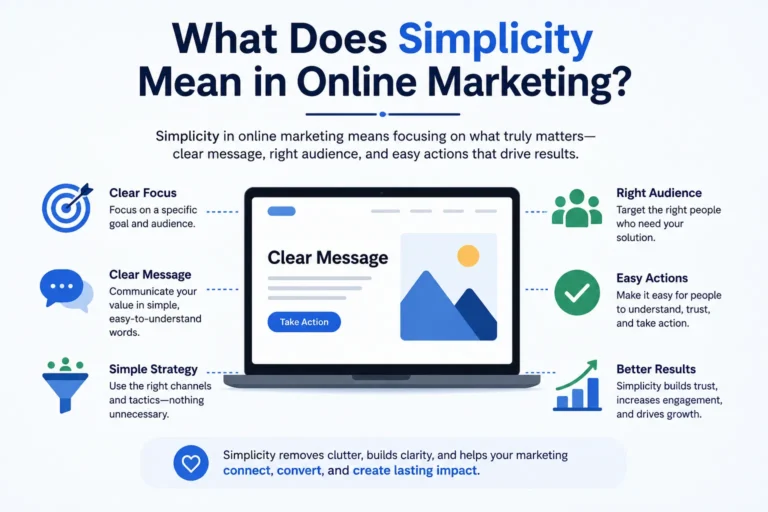
Simplicity in marketing does not mean doing less.
It means being clear.
It means removing everything that does not help the reader take action. It means using plain words instead of jargon. It means designing a page that guides the eye, not confuses it.
Simple marketing has three core parts:
◉ Simple Message — One clear idea. One clear benefit. One clear call to action.
◉Simple Design — Clean layout. White space. Easy-to-read fonts. Minimal distractions.
◉Simple Strategy — Focus on what works. Ignore what does not. Measure results.
When all three come together, marketing becomes powerful.
Why Simplicity Wins in Online Marketing
Faster Understanding
The human brain makes decisions fast. Very fast.
Studies show that people form a first impression of a website in about 50 milliseconds. That is 0.05 seconds.
In that moment, your visitor decides to stay or leave.
A complex, cluttered page loses visitors instantly. A clean, simple page earns their attention.
Fast understanding leads to fast decisions. Fast decisions lead to faster conversions.
Better User Experience
User experience (UX) is how people feel when they use your website or app.
If they feel confused, they leave.
If they feel comfortable, they stay.
Simple design creates a good user experience. It removes friction. It makes navigation easy. It helps the user find what they need without thinking too hard.
Good UX is not just about looks. It is about logic. It is about flow. It is about making the journey from visitor to customer as smooth as possible.
Students enrolled in a digital marketing institute in Surat spend time studying UX because it directly impacts conversion rates and search rankings.
Higher Engagement
Engagement means people read, click, share, and comment.
Simple content gets more engagement than complex content.
Why? Because people do not have time. They scroll fast. They read headlines first. They skim paragraphs.
Short sentences. Simple words. Clear headings. These are the tools that stop the scroll and earn the read.
When people engage, the algorithm rewards you. Social media platforms show your content to more people. Search engines rank your pages higher.
Simplicity creates a loop. Easy content gets read. Getting read earns engagement. Engagement earns reach. Reach earns sales.
Increased Trust
Trust is the foundation of every sale.
When marketing is confusing, people get suspicious. They wonder what you are hiding. They ask, “Why is this so complicated?”
Simple marketing feels honest. It feels direct. It says, “Here is what we do.” Here is how it helps you. Here is what to do next.”
That clarity builds trust faster than any sales script.
A brand that speaks simply speaks with confidence. And confident brands win customers.
Better Conversion Rates
Conversion Rate Optimisation (CRO) is about turning visitors into buyers.
The biggest enemy of conversion is confusion.
When a landing page has too many options, people cannot decide. This is called “choice paralysis”. It is a real psychological phenomenon.
When there is one clear offer and one clear button, people know what to do. Click. Buy. Sign up.
Simple pages convert better. That is not an opinion. It is a measurable, repeatable fact proven by thousands of A/B tests across every industry.
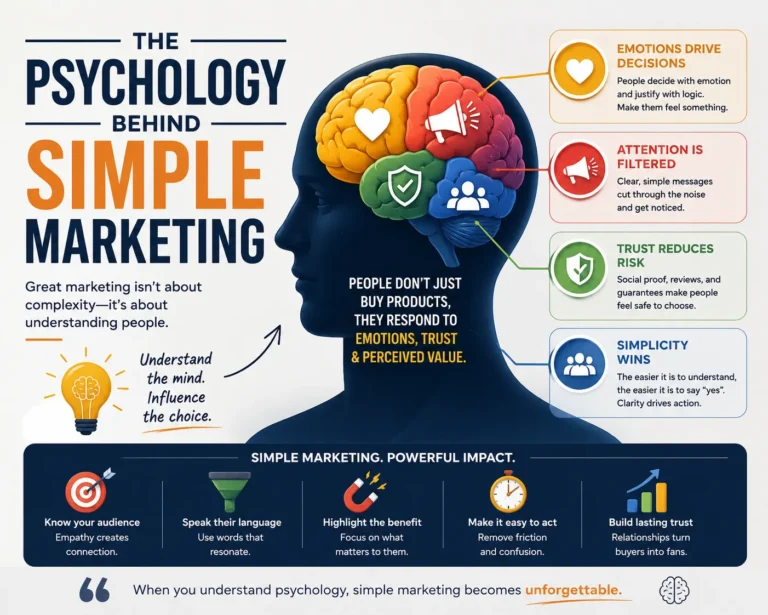
Why does simplicity work so well?
It comes down to how the brain works.
The brain has two main systems. System 1 is fast, automatic, and emotional. System 2 is slow, logical, and deliberate.
Most buying decisions happen in System 1.
Simple marketing speaks directly to System 1. It does not require effort. It does not create resistance. It just feels right.
When your message is easy to process, it feels more true. Psychologists call this “cognitive fluency”. Fluent information feels familiar. Familiar feels safe. Safe feels trustworthy.
This is why simple logos beat complex ones. This is why short taglines are more memorable than long ones. This is why one-click checkout sells more than five-step checkout.
Marketing psychology is a core topic in any quality digital marketing training in Surat. Understanding why people buy helps you craft messages that trigger action — without manipulation.
How Big Brands Use Simplicity to Win
The world’s most successful brands are masters of simplicity.
Apple sells complex technology with a single sentence. “Think Different.” Their product pages are clean, minimal, and focused on one key benefit at a time. There are no walls of text. Just a beautiful image, a headline, and a button.
Google is the most-used website on earth. Its homepage has one text box and two buttons. Nothing else. That simplicity is a design decision, not an accident.
Nike has one of the most recognised taglines in history: “Just Do It.” Three words. Maximum impact.
Amazon built its empire on one simple idea: make buying easy. One-click purchase. Fast shipping. Easy returns. Simplicity at every step of the customer journey.
These brands did not become giants despite keeping things simple. They became giants because of it.
Common Marketing Mistakes That Create Confusion
Many marketers accidentally make things complicated. Here are the most common mistakes:
Too Many Messages Trying to say everything at once says nothing. Pick one message per campaign. One benefit. One audience. One action.
Cluttered Design: Every extra element on a page competes for attention. Remove anything that does not serve the goal of the page.
Weak or Missing Call to Action If visitors do not know what to do next, they do nothing. Make your CTA bold, clear, and specific. “Get My Free Guide” works better than “Submit”.
Using jargon: industry language confuses your audience. Write the way you talk. Use words your customer uses, not words that make you sound impressive.
Ignoring Mobile Users More than 60% of web traffic comes from mobile devices. A complex desktop design becomes a nightmare on a small screen. Keep it simple, and it works everywhere.
Long, Dense Paragraphs Online readers do not read. They scan. Break content into short paragraphs. Use subheadings. Use bullet points when needed. Make it easy to skim.
Understanding these mistakes is a key part of any good SEO course in Surat or digital marketing training programme.
Simple Strategies That Improve Results
You do not need to reinvent marketing. You need to simplify it.
Here are practical strategies that work:
Focus on One Goal Per Page Every page on your website should have one job. A landing page sells. A blog post educates. A product page converts. Do not mix goals.
Use the “One Sentence Test”. Can you describe your offer in one clear sentence? If not, your message is too complex. Keep working until you can pass this test.
Write for a 10-Year-Old Not because your audience is uneducated. Because clarity respects your reader’s time. Simple writing is harder to write but easier to read.
Cut Your Copy in Half Write your first draft. Then remove 50% of the words. The message that remains is almost always better.
Use white space. Empty space on a page is not wasted space. It is breathing room. It guides the eye and reduces cognitive load.
Test One Thing at a Time: A/B testing is a powerful tool. But test one variable at a time — one headline, one button colour, one image. Complexity in testing leads to confusing results.
Simplify Your Funnel Fewer steps mean more completions. Every extra step in a checkout or signup form reduces completion rates. Remove what you can
How Simplicity Improves SEO and Content Marketing
SEO is not just about keywords. It is about satisfying the searcher.
Google rewards content that answers questions clearly and completely. Its algorithm is designed to surface the best, most helpful content, not the most complex.
Simple content earns higher rankings because:
It keeps users on the page longer. Google tracks how long people stay on your content. If they leave fast, that is a bad signal. If they stay and read, that is a great signal.
It earns more backlinks. Simple, clear articles are more likely to be shared and linked to because they are easy to understand and reference.
It wins featured snippets. Google’s featured snippets are pulled from content that answers questions directly and simply. Short, clear answers win these coveted spots.
It performs better in voice search. Voice searches are conversational. Simple, natural language matches how people speak. Complex, jargon-heavy content does not.
For students pursuing an SEO training institute in Surat, understanding how simplicity drives organic traffic is a game-changer. It shifts the focus from tricks and tactics to genuine user value.
Content marketing follows the same rule. The most-shared articles are not the longest. They are the clearest. They say one thing well. They make the reader feel smart, not confused.
Conclusion
Simplicity is not a style choice.
It is a strategy.
Simple marketing messages are understood faster. They build trust more easily. They drive more clicks, more conversions, and more revenue.
The best brands in the world — Apple, Google, Nike, and Amazon — all built their empires on clear, simple communication.
Simplicity works in SEO. It works on social media. It works in content marketing. It works in email campaigns and paid ads. It works everywhere because it matches how the human brain works.
If you want to build a career in marketing that stands the test of time, start with this principle. Learn it deeply. Practice it daily.
A good digital marketing course in Surat will teach you the tools. But the mindset of simplicity is what will set you apart.
Less noise. More clarity. Better results.
That is the power of simple marketing.
Frequently Asked Questions (FAQ)
Why does simplicity work better than complex marketing?
Simplicity works because the brain processes easy information faster and with less resistance. When a message is clear, people understand it quickly and are more likely to act on it. Complex messages create confusion, and confused people do not buy.
How do I simplify my marketing message?
Start by identifying the single most important benefit of your product or service. Write it in one clear sentence. Remove any word that does not add meaning. Test it with someone outside your industry. If they understand it immediately, you have a simple message.
Does simplicity work for all types of businesses?
Yes. Simplicity works for every business type — B2B, B2C, e-commerce, service businesses, and personal brands. The level of detail may vary, but the core principle of clear, focused communication applies universally.
Can simple marketing look professional?
Absolutely. Some of the most professional brands in the world use the simplest designs and messages. Simplicity and quality are not opposites. In fact, simple marketing is often harder to create than complex marketing — it takes more skill to say less.