- Written by: SimbaHardik
- June 5, 2026
- Categories: Blog
- Tags:
Introduction
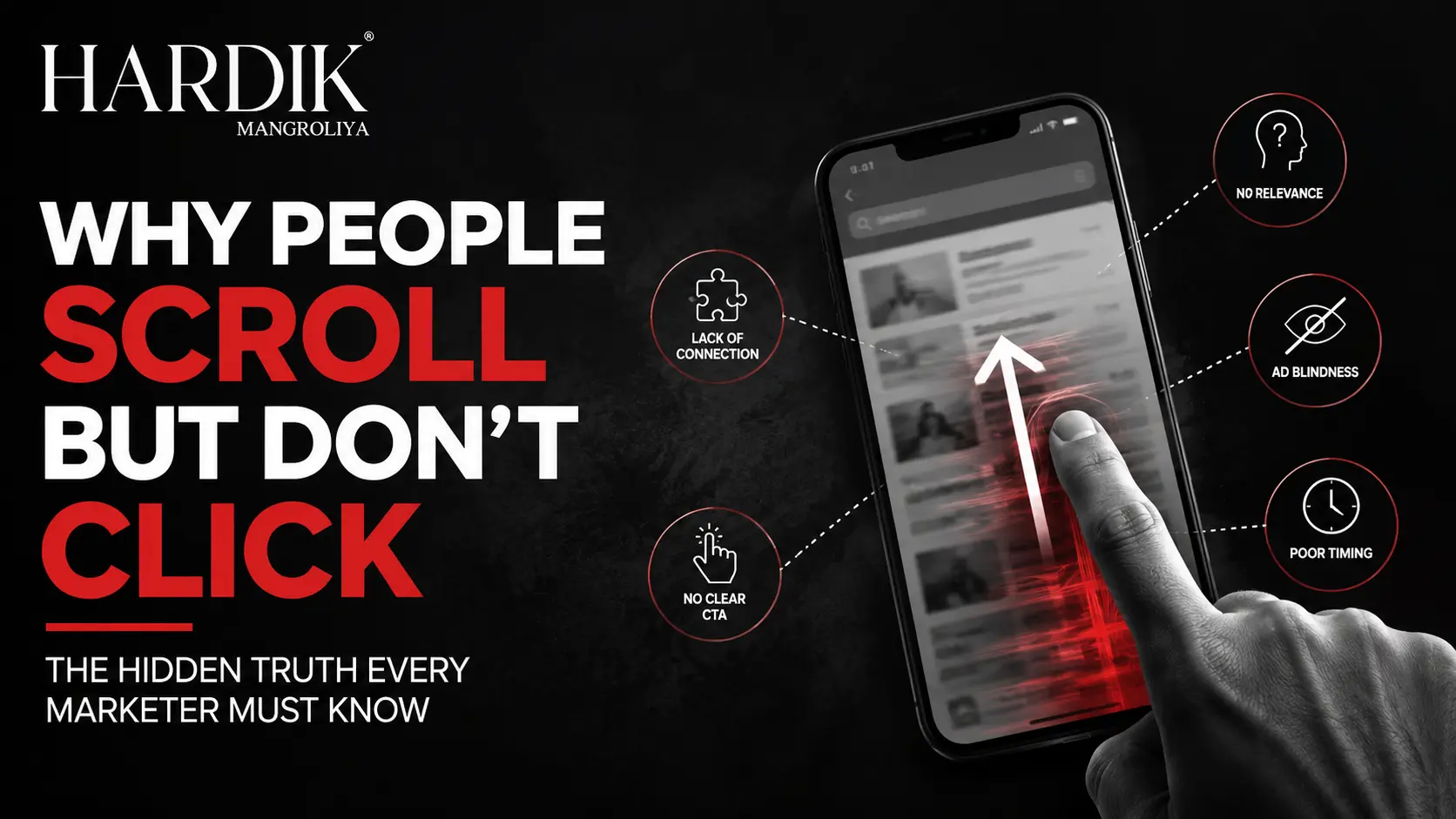
You publish a blog post. You share it on social media. You run an ad. People see it. They scroll right past it. No click. No visit. No conversion.
Sound familiar?
This is one of the biggest problems in digital marketing today. Brands spend thousands on content. They put hours into design. But users just scroll away.
Understanding why people scroll but don’t click is not a luxury. It is a survival skill for every marketer. Whether you manage a small business page or run national campaigns, this problem costs you money every day.
In this guide, you will learn the real reasons behind passive scrolling. You will get practical fixes. And you will see how proper training like a digital marketing course in Surat can help you master user behaviour, content strategy, and conversion optimisation.
Let’s get into it.
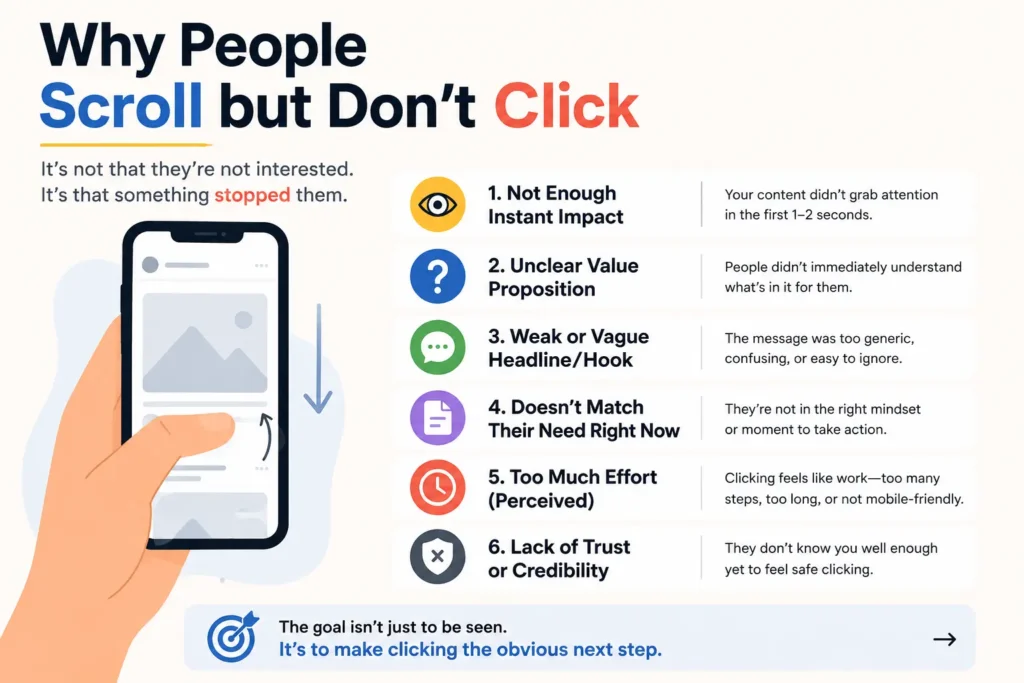
The average person sees over 4,000 ads and pieces of content daily. Their brain filters most of it out. This is called banner blindness. It is a survival mechanism.
Here is the hard truth: most content does not earn a click. It gets seen. Then ignored.
This is not always about bad content. Sometimes it is about bad timing. Sometimes it is about poor positioning. Often it is about a gap between what users want and what content promises.
A scroll without a click tells you one of three things:
● The headline did not connect.
● The content felt irrelevant.
● The user had no reason to trust you.
Each of these is fixable. But first, you need to understand the psychology behind why scrolling has become the default behaviour online.
The Psychology Behind Online Scrolling
Scrolling is addictive by design. Social media platforms built infinite scroll to keep users moving. The brain gets small dopamine hits as new content loads. This creates a loop that is very hard to break.
Users enter a passive state when they scroll. They are not looking to act. They are looking to feel. Curiosity, entertainment, and relief from boredom these drive the scroll.
A click is an active decision. It requires more effort. The brain weighs the risk: “Is this worth my time?” Will this page disappoint me?” boredom –
If the answer is even slightly uncertain, the finger keeps scrolling.
This is why emotional triggers matter so much. A headline that creates genuine curiosity or urgency can break the scroll. A visual that stops the eye can earn a pause. A trust signal can tip the decision toward a click.
Marketers who understand this psychology get more clicks. This is a core topic taught in any strong digital marketing training in Surat because knowing the user’s mind is just as important as knowing the algorithm.
Top Reasons Users Ignore Your Content
Let’s break down the most common barriers between a scroll and a click.
1. Weak Headlines
The headline is your first and often only chance. If it does not promise something specific and valuable, users will not stop.
Weak headline: “5 Marketing Tips”
Strong headline: “5 Marketing Mistakes That Kill Your Click-Through Rate”
The second version creates fear, specificity, and relevance. It speaks to a real pain point.
Good headlines answer one question in the user’s mind: “What’s in it for me?”
2. Poor Content Structure
Even if someone pauses on your content, a wall of text sends them away. Online readers scan before they read. They look for visual anchors, subheadings, bullet points, short paragraphs, and bold key phrases.
If the structure does not make it easy to scan and find value quickly, users move on.
3. No Trust Signals
Would you click a link from a brand you have never heard of with no reviews, no author name, and no credentials?
Most people will not.
Trust signals include author bios, publication dates, real images, social proof, reviews, certifications, and backlinks from credible sources. Without them, your content looks like noise.
4. Slow Websites
Google’s research found that 53% of mobile users leave a page that takes longer than 3 seconds to load.
Even if you earn the click, a slow site wastes it. But beyond that, users are afraid of slow sites. They have learned to associate slow load signals (like a low domain name) with poor quality or unsafe pages.
Page speed is both a ranking factor and a trust factor.
5. Wrong Audience Targeting
Sometimes great content gets shown to the wrong people. A B2B article on enterprise software pushed to college students will get ignored not because the content is bad, but because it is irrelevant to them.
This is a targeting problem, not a content problem. It often happens in Google Ads and social media campaigns where audience segmentation is too broad.
A good Google Ads course in Surat teaches you how to build precise audience segments so your content reaches the right eyes at the right time.
6. Content Overload
Users see too much. When every brand shouts with the same tone, the same format, and the same promises, everything blurs together.
Standing out requires a unique angle. A fresh perspective. A voice that feels real and different.
Generic content gets scrolled past. Specific, original, and honest content gets clicked.

This one surprises many marketers. You can write a well-researched, well-formatted, genuinely useful piece and still get very few clicks.
Here is why:
The SERP is crowded. Ten results appear on page one. Users often choose based on title and meta description alone. If yours blends in, it gets skipped.
The meta description is weak. The meta description is a free ad for your content. If it is generic or cut off, users default to a competitor.
The URL looks untrustworthy. Long, messy URLs with random characters reduce click confidence.
There is no emotional hook. Even informational content can use emotional language. Words like “hidden”, “never”, “mistake”, “truth”, and “finally” trigger curiosity and urgency.
The featured snippet is missing. If your competitor’s content shows up in the answer box at the top of Google, users read the answer there. They never click anyone. You need to optimise for featured snippets: concise, direct answers that Google can pull to the top.
How to Increase Click-Through Rates
Here are practical actions you can take today to improve CTR:
Write power headlines. Use numbers, negative framing, and specificity. “7 Reasons Your Facebook Ads Fail (And How to Fix Them)” beats “Facebook Ads Tips” every time.
Craft a compelling meta description. Treat it as a two-sentence pitch. Include the primary keyword and a clear benefit. Use action language: “Learn”, “Discover”, “See exactly how.”
Use structured data markup. Rich snippets add star ratings, FAQ answers, and recipe details directly in search results. They increase visual appeal and click confidence.
A/B test your titles. Run two headline versions for the same content in email campaigns or paid ads. See which one gets more clicks. Apply those learnings to organic content.
Improve page speed. Use Google’s PageSpeed. Insights to identify issues. Compress images. Remove unused scripts. Use a fast hosting provider.
Create content that matches exact intent. Before writing, search the keyword yourself. Look at the top 5 results. Notice what format they use, what questions they answer, and what they promise. Then do it better.
Build topical authority. One great article helps. A cluster of 10 deep articles on related topics builds trust with Google and users. Brands that clearly know their subject get more clicks over time.
Use social proof in your titles and descriptions. “The Tactic 3,000 Marketers in Surat Use to Double Their Traffic” is more compelling than a generic alternative.
Practical Examples
Example 1: E-commerce Brand
A clothing brand in Surat ran Google Ads with the headline “Shop New Arrivals.”
Click-through rate: 1.2%
They changed it to “New Arrivals: Free Delivery in Surat Ends Tonight.”
Click-through rate jumped to 4.7%.
The change added urgency, location relevance, and a concrete benefit.
Example 2: Educational Institution
A digital marketing institute published a blog post titled “Digital Marketing Information”.
It ranked on page 2 with almost no clicks.
They rewrote the title to “Why Every Business in Surat Needs Digital Marketing” and updated the meta description to highlight local expertise.
Traffic from that post tripled within 60 days.
Conclusion
People scroll because they are trained to scroll. They click when something earns their attention and trust.
The gap between a scroll and a click is not a mystery. It is a combination of weak headlines, mismatched intent, poor trust signals, slow pages, and wrong targeting. All of these are fixable.
The best marketers do not guess. They study user behaviour. They test. They learn from data. They know how to match content to the moment a user is in.
If you want to close the gap between scroll and click in your own campaigns, start with education. A digital marketing course in Surat will teach you the skills to build content that converts — from SEO and PPC advertising to content marketing, email marketing, and beyond.
The scroll stops when the content earns it. Now you know how to earn it.
FAQ Section
Q1: Why do users scroll past content without clicking?
Users scroll past content that does not immediately promise clear value. Weak headlines, poor trust signals, slow pages, and mismatched intent are the top reasons. The fix starts with knowing your audience and writing for their specific needs.
Q2: What is click-through rate (CTR), and why does it matter?
CTR is the percentage of users who see your content and click on it. A higher CTR means more traffic from the same number of impressions. It is a key metric in both SEO and paid advertising. Low CTR tells search engines your content is not relevant, which can lower your rankings over time.
Q3: How does search engine optimisation affect click-through rates?
SEO determines where you rank and how your listing appears. A well-optimised title tag, meta description, and URL all influence whether users choose to click your result. Better SEO means more visibility — but visibility only converts to traffic if your listing is compelling.
Q4: Can a Google Ads course in Surat help me improve paid ad CTR?
Yes. A quality Google Ads Course in Surat teaches you how to write high-performing ad copy, set up audience targeting, run A/B tests, and use Quality Score to reduce ad costs while